Small AI interface updates: keep control of the screen
Treat a model response as a bounded data change rather than executable interface code. Try a fixed-seed JSON preview that rejects stale responses, unknown fields and invalid values.
Checking local voices…
In brief
Treat a model response as a bounded data change rather than executable interface code. Try a fixed-seed JSON preview that rejects stale responses, unknown fields and invalid values.
On this page
Suppose an AI assistant needs to revise a card title, shorten its summary and update a progress indicator. Instead of regenerating the interface, it can propose a small change to those three fields. This is an application design approach rather than a special React feature: model output is constrained by a contract the application owns. The experiment makes no model request and never executes the text a visitor enters as code.
Define the editable surface first
Not every field on the screen needs to be available to a model. This example allows title, summary and progress; request identifies the operation the response belongs to. Unknown fields are rejected. Changing a button destination, user identity or hidden setting is outside this data path. A small allowed surface also makes the expected behavior easier to inspect and test.
Describe more than a successful response. Decide what happens when the title is empty, the summary is too long or progress exceeds one hundred. A slider in the interface does not establish a rule for values arriving from another source. Apply the contract where the response is accepted. A real server must enforce its own authorization and validation boundaries for any changes it persists.
Separate parsing from acceptance
Successfully parsing JSON completes only part of a format check. An array, a wrong value type or an unexpected field can still be valid JSON. Acceptance should depend on the application’s schema and business rules. In the experiment, try a string where a number is expected, an empty title and an extra field. Each tests a different part of that decision.
Rejection should leave an understandable result. Rather than blanking the screen or applying half a change, the application can preserve the last valid state. The reader sees that a proposal failed without losing the existing text. This does not hide an error; it separates a failed proposal from the current accepted interface. If diagnostic records are needed, collecting every complete model response should not become an unquestioned default.
Experiment: Small AI interface updates
A safe simulation. No real requests, messages or payments; choices stay on this page.
Allowed fields: request, title, summary, progress. Old request identifiers and unknown fields are rejected.
{
  "title": "New title",
  "summary": "Existing summary",
  "progress": 60
}Your selected settings and server-recomputed result download with the article. Your choices are not saved to the database.
Match the response to the current operation
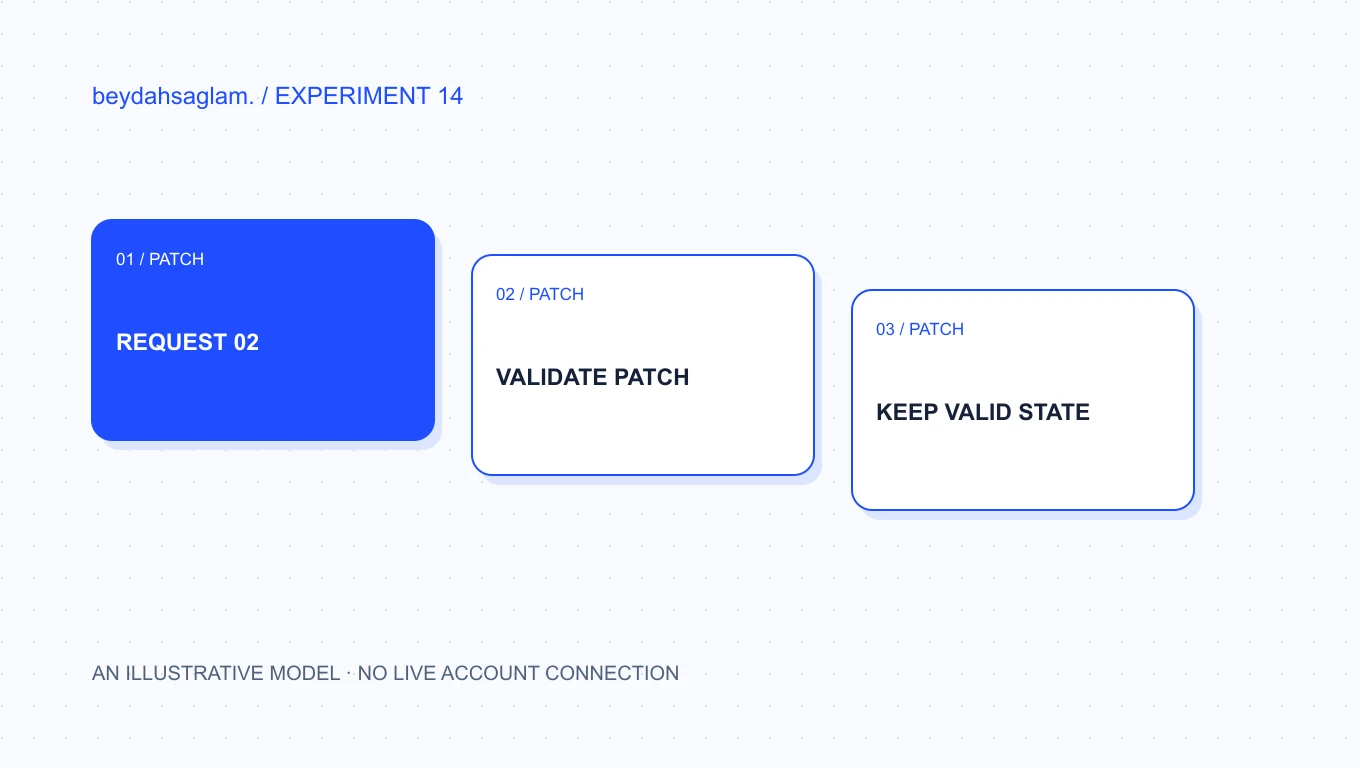
Asynchronous responses do not have to finish in the order they started. The first request may still be running when a visitor starts a second. A late first response should not overwrite the newer card. The current request identifier starts at two and can be changed from 1 to 10; a patch is rejected when its request value does not match the selected identifier. The number is an illustrative sequencing value, not a user or database identifier.
In a real application, define how a new operation advances the version, what cancellation means and where a result goes after the component closes. Checking a request identity and cancelling a network operation are different mechanisms. Implementing one does not automatically provide the other’s behavior. A clear stale-result state can make the outcome easier to understand than silently mixing results from separate requests.
Preserve existing state deliberately
A partial update need not replace the entire state. This experiment evaluates each JSON patch against a fixed seed card: Original title, Existing summary and 0. A progress-only patch takes its title and summary from those seed values; earlier accepted patches are not accumulated. Merging into the last valid state must be implemented separately in a real application. React’s object-state guidance explains updating with new objects rather than directly mutating state. Nested structures need copies at the relevant levels; this experiment uses a flat object.
Showing accepted fields helps a reviewer understand the effect. Did the title change, or only the progress value? Keep that distinction visible. Do not hide persistence or publication inside the same apparently visual operation. A changed preview does not prove that a database row was saved or that a public page changed. Each external effect deserves its own explicit outcome and appropriate authorization.
Start with small rejection examples
Begin with a valid progress update. Then add an unknown field, change request to the older value and try a number outside the allowed range. After every rejection, observe that the experiment displays the fixed seed card; it does not retain the previous accepted preview. If your real application should preserve the last valid view, implement and test that behavior separately. This sequence teaches more than a demonstration of the happy path alone. Avoid adding a shortcut that interprets arbitrary text as HTML just to make a more dramatic visual demo.
The PDF contains the selected JSON sample and the model’s computed acceptance result. Use artificial examples rather than secrets or personal details. You can attach the output to a contract review note. As a next development step, defining one real screen’s editable fields and rejection behavior is more observable than claiming that the entire application can now be generated dynamically without additional boundaries.
Source
Frequently asked questions
Is JSON.parse enough?
No. Parsing establishes that text follows JSON syntax. Your application still needs rules for allowed fields, types, lengths, ranges and the current request. A syntactically valid JSON value can be an invalid update under that contract, including a value of the wrong top-level type.
Should the model generate HTML?
This example accepts no HTML. It updates predefined text and progress fields. A different product may need a broader system, but that introduces its own trust boundary and security review. Do not quietly turn a data update into executable code or assume that a parsed value is safe to render as markup.
Why does an old response matter?
Requests may finish out of order. A response from the first request can arrive after the second and overwrite a newer screen. The experiment’s request field illustrates acceptance only for the current operation. Real applications must also handle cancellation, component lifetime and the actual source of each response.
Does a partial update remove other fields?
In this experiment, omitted fields come from a fixed seed card; earlier accepted patches are not accumulated. In a real application, define explicitly which existing state receives a partial update. Nested objects deserve particular care because a shallow copy does not independently copy every nested object.
Does this provide complete security?
No. It models interface state rather than user authorization, server validation, external effects or record ownership. Those boundaries need separate enforcement. Updating a preview does not grant permission to persist, publish or send the result to another service.