Two languages, two addresses: pair article URLs deliberately
A Turkish article and its English edition can use different readable slugs. Pair the editions when the translation exists; avoid publishing an empty English page. Find missing relationships in the small experiment.
Checking local voices…
In brief
A Turkish article and its English edition can use different readable slugs. Pair the editions when the translation exists; avoid publishing an empty English page. Find missing relationships in the small experiment.
On this page
Translating an article is more than filling a second text field. A reader arrives from a listing, shares a link, switches language or opens an old address. Each path should reach the intended edition of the same content. On this site, Turkish and English articles may have different slugs, and an article without an English edition does not appear in the English listing. The following approach explains how to review that behavior.
Keep the address separate from edition identity
A slug chosen for a Turkish title may not be the clearest phrase for an English reader. Separate fields make that editorial choice possible. Inferring the relationship only from similar text, however, is fragile. Linking the editions through the same underlying content record helps preserve their relationship when a title or address changes. The address is one public representation of the edition, not its entire identity.
Write the Turkish and English addresses beside each other and mark which edition is actually ready. A nonempty slug does not prove that a translation exists. Check the title, summary, body and required materials in the target language as well. This separates planning an address from offering a usable public page, which is particularly helpful when translations are prepared gradually.
Do not invent an unavailable translation
Showing Turkish text in an English listing creates an expectation the page cannot meet. This site leaves unavailable editions out of that listing and the sitemap. Work can continue in the administrator’s draft without creating a public alternative prematurely. The public relationship should reflect publication readiness rather than the mere presence of fields in the database.
The language switch needs a deliberate fallback too. If the current article has no counterpart, do not generate a link that implies one exists. A general blog listing can be a destination, but it should not be presented as the same article’s translation. A successful transition means more than receiving HTTP 200: the destination and the reader’s expectation should agree.
Experiment: Two languages, two addresses
A safe simulation. No real requests, messages or payments; choices stay on this page.
Your selected settings and server-recomputed result download with the article. Your choices are not saved to the database.
Make language alternatives reciprocal
Google’s localized versions guidance describes fully qualified hreflang addresses and reciprocal relationships between editions. Each page also includes its own version in the declared set. If Turkish names an English alternative while English omits the Turkish return relationship, that is a pairing issue worth investigating. Choosing one consistent implementation method makes the relationship easier to inspect than adding redundant layers without a clear reason.
Technical markup does not replace content quality. The visible title, language, link label and body should describe the same edition. A correct tag can coexist with the wrong title on screen. Open the page as a reader as well as inspecting the markup. This catches a different class of problem from a simple search for the presence of hreflang.
Canonical answers a different question
A canonical is a preferred-address signal; language alternatives describe a relationship between editions. In this site’s TR/EN design, genuine editions use their own localized canonical addresses. Automatically pointing English to Turkish can conflict with the intended two-edition behavior. A particular application may have additional duplicate-content cases, so the design still requires contextual review.
Create separate columns for the opened URL, canonical URL and language alternatives. Include the final destination of old-slug redirects. Before trusting a green check in a tool, identify which relationship it actually checked. Finding a canonical element does not prove that a language switch reaches the corresponding article, or that the English body has been translated.
Match old links to equivalent content
When a slug changes, consider links already shared elsewhere. A permanent redirect from the old Turkish address to the same article’s new Turkish edition can make sense. Sending every unmatched WordPress address to the home page does not preserve that intent. Find the real equivalent first, then distinguish drafts, removed pages and genuinely relocated material. This is a mapping exercise rather than a blanket redirect rule.
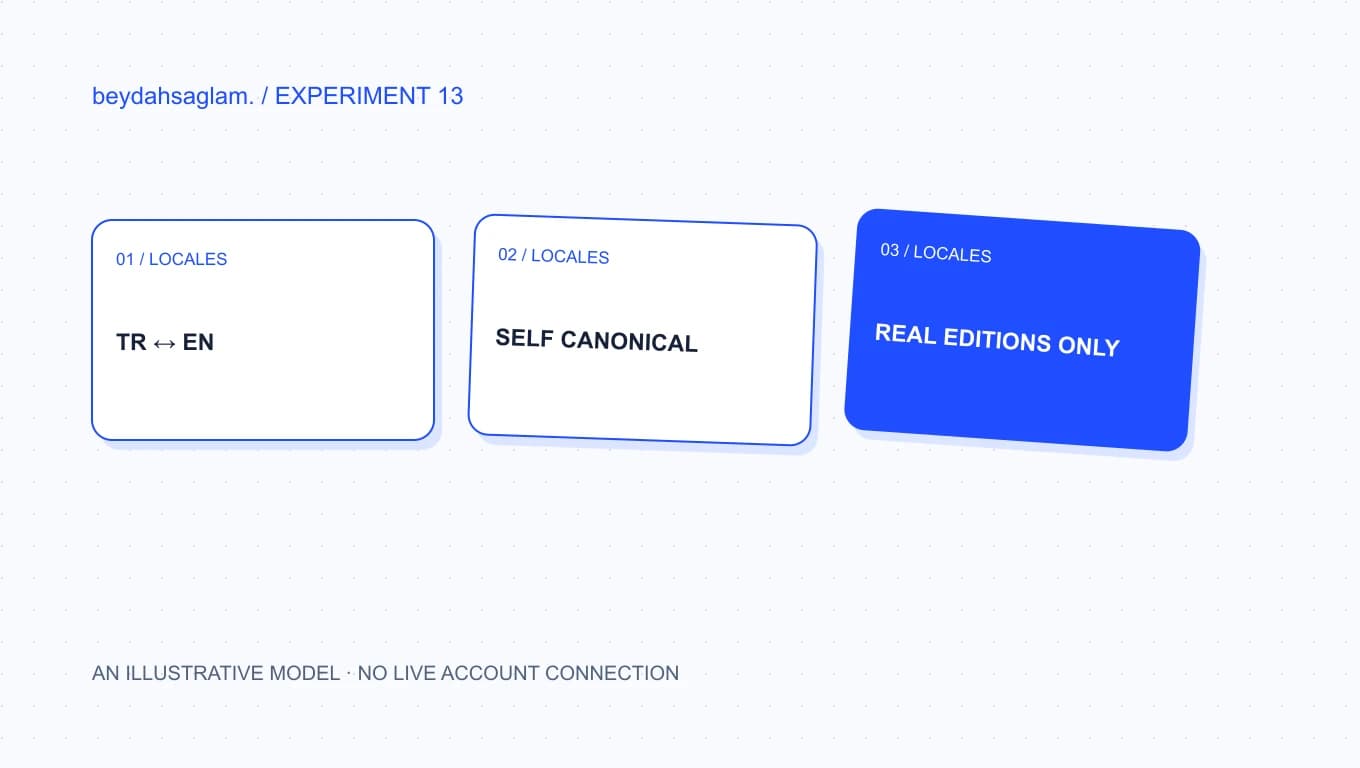
The experiment lets you change English availability, reciprocal pairing and canonical consistency. It does not crawl a real website; it shows how these three decisions produce different diagnoses. Export the result as a PDF beside your own review notes. Starting with one complete path from listing to legacy link gives stronger evidence than making a site-wide SEO claim before checking actual pages.
Source
Frequently asked questions
Can both languages use the same slug?
Yes. Different slugs are a choice rather than a requirement. This site prefers addresses that read naturally in each language. Consistent routing, correct internal links and an actual edition in the stated language matter more than making every address visibly different.
What should appear when English is not ready?
You can leave the article out of the English listing rather than publish an empty page or relabel Turkish text. That is this site’s approach. The translation remains a private draft; language alternatives and sitemap entries are evaluated when the edition is actually published.
Should every canonical point to Turkish?
Do not automatically collapse genuine language editions into one Turkish address. In this design, each edition has its own localized canonical and uses hreflang to describe language alternatives. Evaluate unusual duplicate or regional cases separately instead of treating this pattern as a universal instruction.
Does hreflang guarantee ranking?
No. It helps communicate language or regional alternatives. It does not replace useful content, accessible pages or other technical requirements. Google documents implementation details such as reciprocal links and complete URLs; those details are not a promise of search visibility.
What happens to an old slug?
First identify its genuine equivalent. A permanent redirect to the same article’s new localized address may preserve the reader’s intent. Sending every unmatched draft or removed WordPress URL to the home page produces an unrelated destination, so review old addresses according to their actual content.